
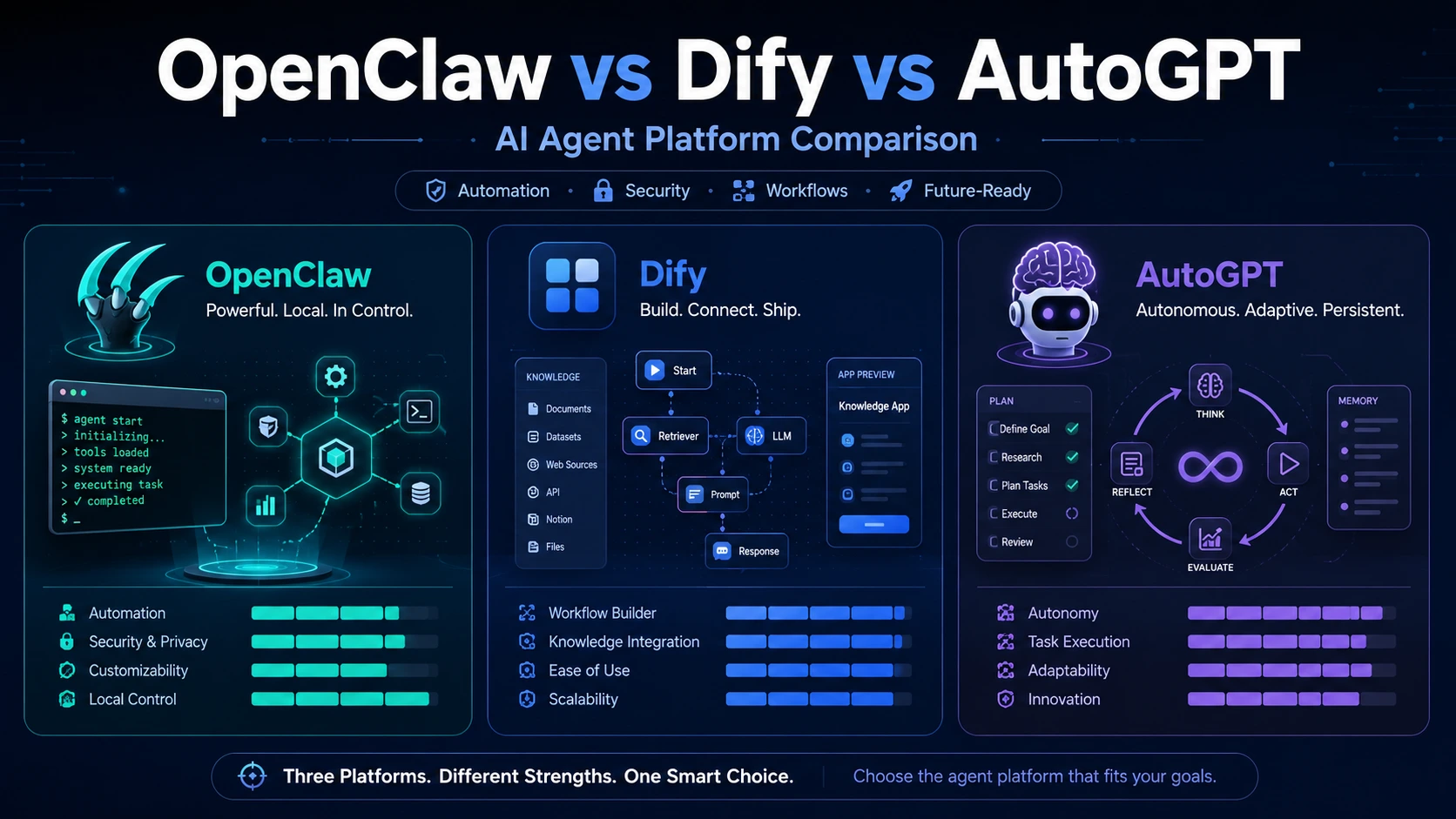
OpenClaw vs Dify vs AutoGPT is one of the most important comparisons for businesses, developers, and AI automation teams in 2026. As AI agents move from simple chatbots to real task execution, companies need to know which platform is practical, secure, scalable, and future-ready.
Google’s current content guidance focuses on helpful, reliable, people-first content, clear sourcing, originality, page experience, trust, and transparency around AI-assisted content. Google also says generative AI can be useful for research and structure, but content must add real value and avoid scaled, low-quality, search-first publishing. (Google for Developers)
This guide compares:
- OpenClaw – Best for local-first, open-source AI agents and deep automation
- Dify – Best for visual AI workflow building, RAG apps, and production AI applications
- AutoGPT – Best for autonomous experimentation and agent-based task execution
Table of Contents
What Is OpenClaw?
OpenClaw is an open-source AI agent platform designed to run locally or on self-hosted infrastructure. It connects large language models with tools, messaging channels, files, commands, browsers, calendars, email systems, and other workflows.
Public OpenClaw documentation describes it as an open-source AI agent platform that can support many communication channels and skills from a self-hosted instance. (openclawdoc.com)
In simple terms, OpenClaw is not only a chatbot. It is closer to a personal or business AI operator that can take action.
Key OpenClaw Strengths
- Open-source and self-hostable
- Local-first control
- Strong automation flexibility
- Multi-channel communication support
- Can connect with coding, browser, email, and workflow tools
- Useful for technical teams that want full control
Key OpenClaw Weaknesses
- Requires technical setup
- Security must be configured carefully
- Local execution can create risk if permissions are too open
- Maintenance may require developer involvement
- Not ideal for non-technical users without support
OpenClaw has gained strong public attention in 2026, with reports describing it as a fast-growing open-source AI agent project. Some reports also highlight major token usage and security concerns around real-world deployments, which means businesses should treat OpenClaw as powerful but not “set and forget.” (Tom’s Hardware)
What Is Dify?
Dify is an open-source platform for building agentic workflows, AI apps, chatbots, knowledge-base assistants, RAG pipelines, and production-ready AI applications.
Dify’s official documentation says it lets users define processes visually, connect tools and data sources, and deploy AI applications that solve real problems. (Dify Docs)
Dify is often easier for business teams because it includes a visual workflow builder, RAG support, model provider management, publishing options, monitoring, logs, plugins, and deployment tools.
Key Dify Strengths
- Visual workflow builder
- Strong RAG and knowledge-base support
- Good for business AI apps
- Supports multiple LLM providers
- Better for teams that need production workflows
- Easier than code-heavy agent frameworks
Key Dify Weaknesses
- Less flexible than raw agent frameworks for deep local automation
- Some advanced workflows still need technical knowledge
- Cloud vs self-hosting decisions must be reviewed carefully
- May feel heavier than lightweight agent tools
Dify’s official website highlights visual AI workflow creation, global LLM support, RAG pipelines, tools, plugins, MCP integration, and enterprise infrastructure positioning. (Dify)
What Is AutoGPT?
AutoGPT is one of the most recognized early autonomous AI agent projects. It became popular because it showed how an AI system could break a goal into steps, use tools, and attempt to complete tasks with less manual prompting.
The official GitHub page describes AutoGPT as part of a vision to make AI accessible for everyone and provide tools so users can focus on what matters. (GitHub)
Key AutoGPT Strengths
- Well-known AI agent project
- Good for experimentation
- Strong developer community awareness
- Useful for testing autonomous task execution
- Good educational value for understanding agent behavior
Key AutoGPT Weaknesses
- Can be less predictable for business-critical automation
- Requires careful task control
- May need technical setup and tuning
- Not always the best choice for production workflows
- More experimental compared with Dify-style workflow platforms
AutoGPT is best viewed as a strong experimental and developer-focused AI agent platform rather than a plug-and-play business automation system.
Quick Comparison Table
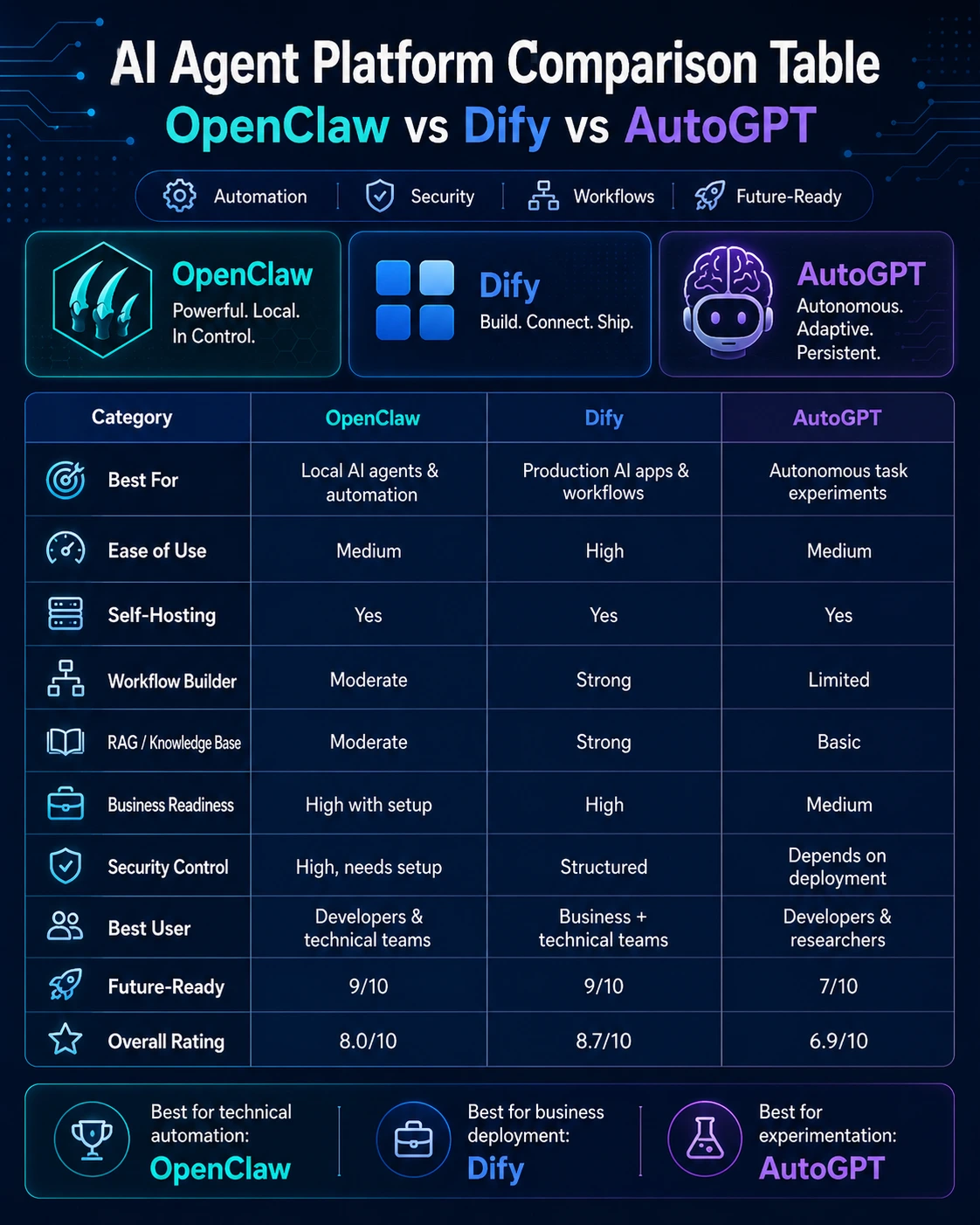
| Feature | OpenClaw | Dify | AutoGPT |
|---|---|---|---|
| Best For | Local AI agents and automation | Production AI apps and workflows | Autonomous task experimentation |
| Skill Level Needed | Medium to high | Low to medium | Medium |
| Self-Hosting | Yes | Yes | Yes |
| Visual Builder | Limited / depends on setup | Strong | Limited / platform-dependent |
| RAG Support | Possible through integrations | Strong | Possible but less central |
| Multi-Channel Use | Strong | Moderate | Moderate |
| Business Readiness | Medium to high with setup | High | Medium |
| Security Control | High, but risky if misconfigured | Stronger managed structure | Depends on deployment |
| Best User | Developer / technical AI team | Business + technical team | Developer / AI experimenter |
| Future Potential | Very high | Very high | Medium to high |
Technology Rating
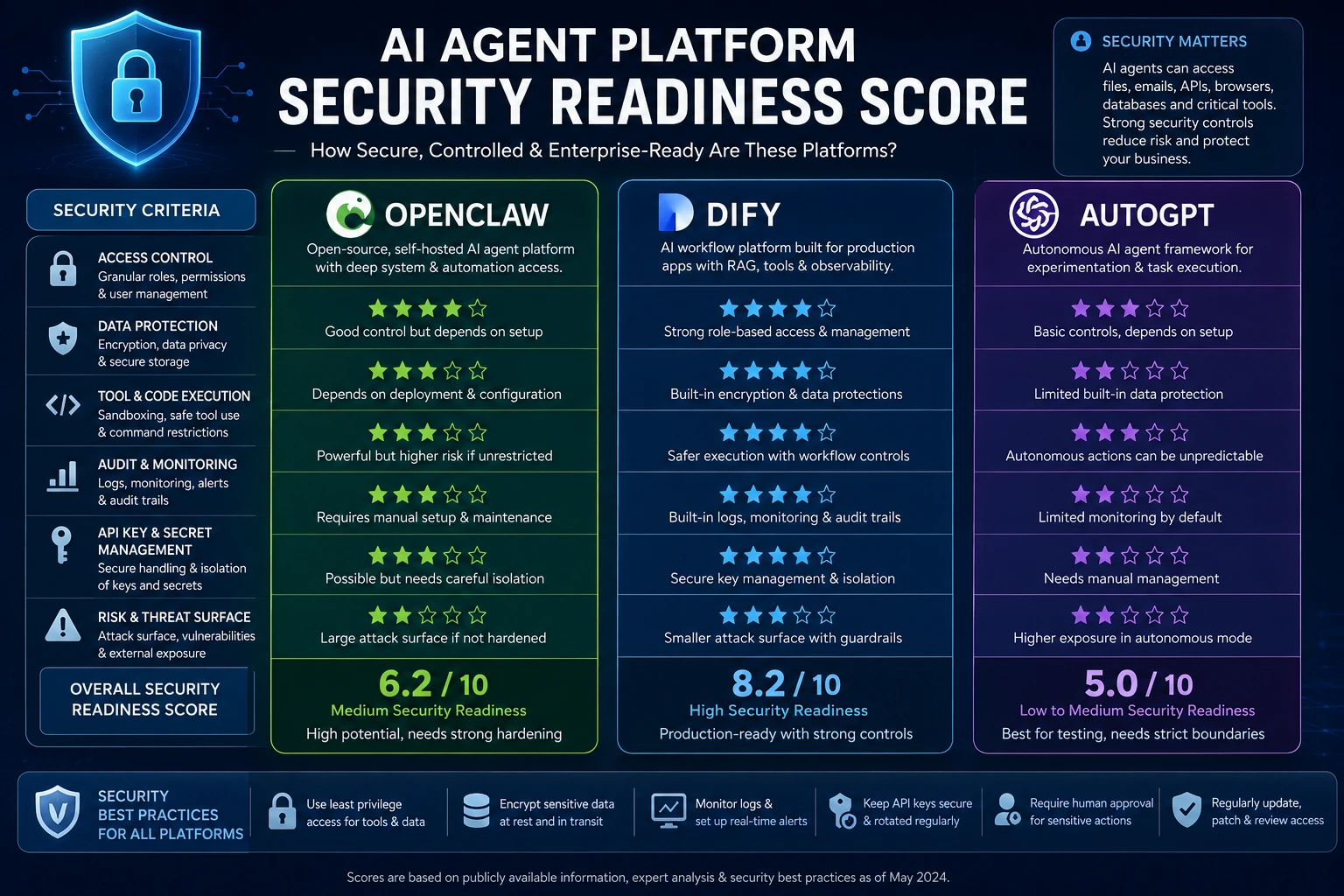
| Category | OpenClaw | Dify | AutoGPT |
|---|---|---|---|
| Automation Power | 9/10 | 8/10 | 7/10 |
| Ease of Use | 6/10 | 9/10 | 6/10 |
| Developer Flexibility | 9/10 | 8/10 | 8/10 |
| Business Usability | 7/10 | 9/10 | 6/10 |
| Security Readiness | 6/10 | 8/10 | 6/10 |
| Scalability | 8/10 | 9/10 | 7/10 |
| RAG / Knowledge Base | 7/10 | 9/10 | 6/10 |
| Future Readiness | 9/10 | 9/10 | 7/10 |
Overall Rating
- OpenClaw: 8.0/10
- Dify: 8.7/10
- AutoGPT: 6.9/10
Winner for technical automation: OpenClaw
Winner for business deployment: Dify
Winner for experimentation: AutoGPT
Security and Trust Signals
Security is one of the most important factors when choosing an AI agent platform. AI agents can access files, APIs, browsers, email, calendars, databases, and internal tools. Therefore, one wrong permission can create serious business risk.
OpenClaw Security Review
OpenClaw is powerful because it can operate close to the local system. However, that also creates risk. Recent research on OpenClaw-style deployments has discussed attack surfaces involving local system access, persistent state, identity, knowledge, and capabilities. Another study reviewed advisories around OpenClaw’s architecture, including tool execution, gateway, plugin, and sandbox concerns. (arXiv)
Trust signal: Strong open-source visibility
Risk signal: Requires serious security configuration
Best practice: Use sandboxing, limited permissions, API key isolation, logs, and human approval for sensitive tasks.
Dify Security Review
Dify is more structured for business AI apps. Its official site positions the platform around scalable, stable, secure infrastructure, with workflow, RAG, tools, plugins, MCP, and observability features. (Dify)
Trust signal: Better business workflow structure
Risk signal: Data source and model provider configuration must be reviewed
Best practice: Use role-based access, secure API keys, private knowledge bases, and audit logs.
AutoGPT Security Review
AutoGPT can be useful for autonomous workflows, but like all agent platforms, it should not be given unrestricted access to sensitive systems without controls.
Trust signal: Large open-source awareness
Risk signal: Autonomous tasks can behave unpredictably
Best practice: Use test environments, limited tool access, and manual approval before execution.
Statistics and Market Signals
AI agent adoption is growing because businesses want systems that do more than answer questions. They want AI that can:
- Research
- Plan
- Write
- Code
- Update CRM records
- Create reports
- Search documents
- Trigger workflows
- Assist customers
- Monitor tasks
OpenClaw has received major attention in 2026, with technology media describing it as a fast-growing open-source AI agent framework. Reports also mention very high token usage from OpenClaw-related development and agent operations, showing both the power and cost risk of autonomous agent systems. (Tom’s Hardware)
Dify has strong positioning as a production-ready agentic workflow builder with RAG, MCP, plugins, monitoring, and multi-model support. (Dify Docs)
AutoGPT remains important because it helped popularize autonomous AI agents and continues to be recognized as a major open-source AI agent project. (GitHub)
End-to-End Business Use Case Comparison
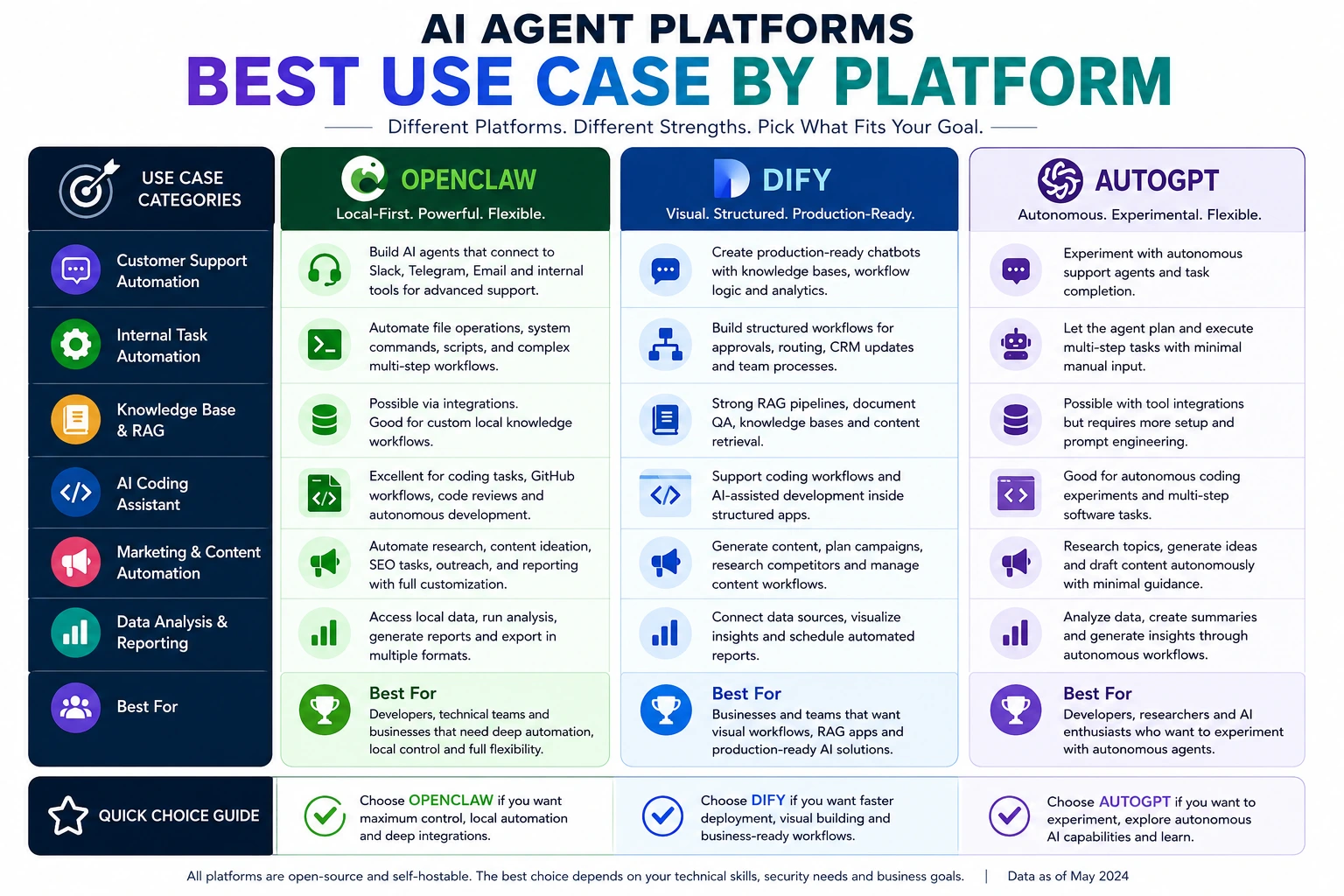
1. Customer Support Automation
OpenClaw:
Good for technical teams that want an AI support agent connected to Telegram, Slack, email, or internal tools.
Dify:
Best choice for most businesses. It can create support chatbots, connect a knowledge base, monitor logs, and publish AI apps.
AutoGPT:
Useful for testing support workflows, but not the best first choice for live customer support.
Winner: Dify
2. Internal Task Automation
OpenClaw:
Excellent for local task automation, file operations, coding tasks, and command-based workflows.
Dify:
Great for structured business processes such as document Q&A, lead qualification, reporting, and CRM workflow support.
AutoGPT:
Good for experimental autonomous task planning.
Winner: OpenClaw for technical automation; Dify for business workflows.
3. AI Knowledge Base and RAG
OpenClaw:
Can support knowledge workflows, but setup depends on integrations.
Dify:
Strong RAG pipeline support is one of its biggest advantages.
AutoGPT:
Possible, but not its strongest use case.
Winner: Dify
4. AI Coding Assistant
OpenClaw:
Strong for coding-related automation and GitHub-style workflows when configured correctly.
Dify:
Can support coding workflows, but it is not mainly a coding agent.
AutoGPT:
Useful for code experimentation, but output needs review.
Winner: OpenClaw
5. SMB Digital Marketing Automation
For small and medium-sized businesses, AI automation can support:
- Lead follow-up
- SEO planning
- Blog topic research
- CRM updates
- Review response drafting
- Monthly report summaries
- Social media content planning
- Customer inquiry routing
OpenClaw is strong when the agency has technical control.
Dify is better when the business needs repeatable workflows and dashboards.
AutoGPT is better for testing ideas before building a production workflow.
Winner: Dify for most SMBs.
Future-Ready Analysis
Is OpenClaw Future-Ready?
Yes, but mainly for technical teams. OpenClaw fits the future of local-first AI, private agents, self-hosted automation, and multi-tool execution.
However, future readiness depends on:
- Security hardening
- Permission control
- Skill marketplace quality
- Governance
- Enterprise deployment practices
Future-ready score: 9/10
Is Dify Future-Ready?
Yes. Dify is highly future-ready because it aligns with where businesses are going: visual AI workflows, RAG, multi-model support, MCP integration, observability, and production deployment.
Dify is also more practical for teams that want AI apps without building everything from scratch.
Future-ready score: 9/10
Is AutoGPT Future-Ready?
AutoGPT is still relevant, but its strongest future role may be education, experimentation, and autonomous agent research. For business production, Dify and OpenClaw may be stronger choices.
Future-ready score: 7/10
Best Examples for Small and Medium Businesses
Example 1: AI Lead Follow-Up Assistant
A local service business receives leads from Facebook Ads, Google Ads, and website forms.
Best platform: Dify
Why: It can structure workflows, connect knowledge, and generate controlled responses.
Example 2: Internal AI Operations Agent
A technical agency wants an AI assistant that can check files, run commands, create reports, and update internal systems.
Best platform: OpenClaw
Why: It gives more local control and deep automation flexibility.
Example 3: AI Research Experiment A developer wants to test whether an AI agent can plan and complete multi-step tasks.
Best platform: AutoGPT
Why: It is useful for autonomous AI experimentation.
Example 4: AI SEO Content Planner
A marketing agency wants AI to generate topic clusters, competitor research, content briefs, and FAQs.
Best platform: Dify or OpenClaw
Why: Dify is easier for structured workflows. OpenClaw is stronger if the team wants deeper automation.
How to Choose the Right Platform
Choose OpenClaw if:
- You want self-hosted AI agents
- You have technical staff
- You need local automation
- You want deep control
- You can manage security carefully
Choose Dify if:
- You want business-ready AI workflows
- You need RAG and knowledge-base apps
- You prefer a visual builder
- You want faster deployment
- You need monitoring and app publishing
Choose AutoGPT if:
- You want to experiment with autonomous agents
- You are learning agent architecture
- You want a developer-focused test environment
- You do not need immediate production stability
FAQs
1. Is OpenClaw better than Dify?
OpenClaw is better for technical users who want local-first AI agents and deep system automation. Dify is better for business teams that want visual workflows, RAG apps, and faster production deployment.
2. Is Dify better than AutoGPT?
For most business use cases, yes. Dify is more structured for production AI applications. AutoGPT is better for autonomous AI experiments and learning how agents work.
3. Is OpenClaw safe for business use?
OpenClaw can be used safely, but only with proper configuration. Businesses should limit permissions, protect API keys, use sandboxing, monitor logs, and require human approval for sensitive actions.
4. Which platform is best for small businesses?
Dify is usually the best first choice for small businesses because it is easier to use, supports knowledge bases, and provides structured workflow building. OpenClaw is better when a technical team manages the setup.
5. Which platform is best for developers?
OpenClaw is best for developers who want flexible local automation. AutoGPT is best for experimentation. Dify is best for developers building AI apps for business users.
6. Can OpenClaw replace Zapier or Make?
Not directly for every user. OpenClaw is more agentic and flexible, while Zapier and Make are more traditional workflow automation tools. OpenClaw may replace parts of those tools for technical teams, but non-technical users may prefer visual workflow platforms.
7. Can Dify build AI chatbots?
Yes. Dify can build chatbots, RAG-based assistants, AI workflows, and agentic applications using visual tools and connected data sources. (Dify Docs)
8. Is AutoGPT still useful?
Yes. AutoGPT is still useful for learning, testing, and experimenting with autonomous AI workflows. However, businesses should carefully evaluate reliability before using it for production tasks.
Final Verdict
OpenClaw vs Dify vs AutoGPT is not a one-size-fits-all decision.
For most businesses, Dify is the safest and most practical starting point because it offers visual workflow building, RAG support, monitoring, and production-friendly deployment.
For technical teams, OpenClaw is the most powerful choice because it supports local-first AI agents, deeper automation, and high flexibility. However, it needs careful security setup.
For developers and AI learners, AutoGPT remains useful as an experimental autonomous agent platform.
Best Choice by Need
| Need | Best Platform |
|---|---|
| Business AI workflow | Dify |
| Local AI automation | OpenClaw |
| AI experiment | AutoGPT |
| RAG chatbot | Dify |
| Developer agent | OpenClaw |
| Learning autonomous AI | AutoGPT |
| SMB automation | Dify |
| Advanced self-hosted AI agent | OpenClaw |
Need Help Choosing the Right AI Agent Platform?
Start with one clear workflow, such as customer support, CRM updates, SEO planning, lead follow-up, or reporting automation. Then choose the platform based on security, usability, and scalability.
“This article was prepared with AI-assisted research and editorial support. The final content was reviewed and edited for accuracy, clarity, usefulness, and business relevance.”