
AI automation for small and medium-sized businesses is no longer a future idea. It is becoming a practical way for companies to save time, improve customer response, manage leads, support marketing, and make better decisions. Many business owners still think artificial intelligence is only for large corporations with big budgets. However, that is no longer true.
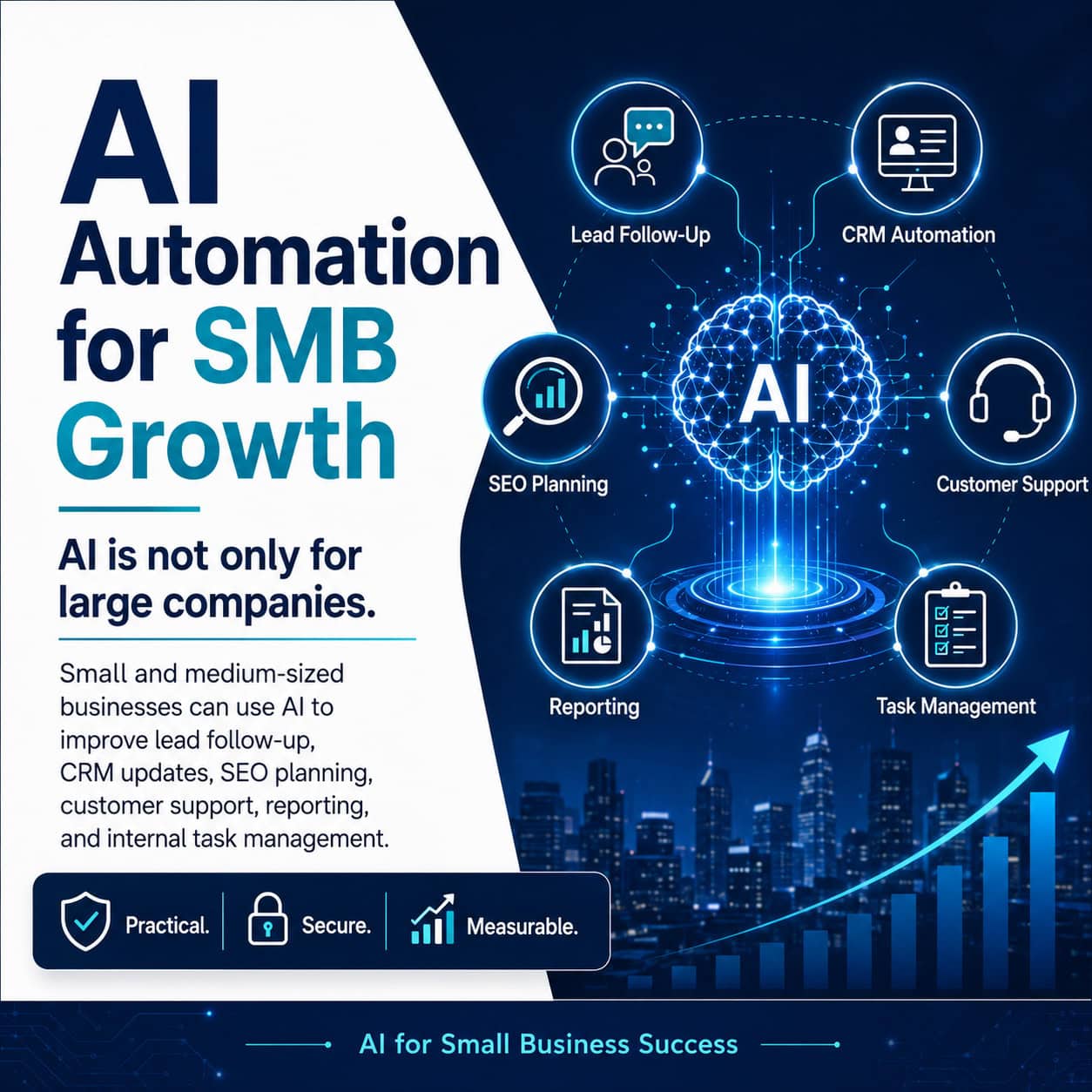
Today, small and medium-sized businesses can use AI tools for CRM automation, SEO planning, customer support, reporting, internal task management, and lead follow-up. As a result, teams can reduce repetitive work and focus more on strategy, service quality, and business growth.
AI does not need to replace human decision-making. Instead, it should support business owners, managers, sales teams, marketing teams, and support teams with faster information, better organization, and more consistent follow-up.
This article explains how SMBs can use AI automation in a practical, secure, and measurable way.
Table of Contents
What Is AI Automation for SMBs?
AI automation means using artificial intelligence and automation tools to handle repetitive, time-consuming, or data-based tasks. For small and medium-sized businesses, this can include simple workflows such as replying to common customer questions, assigning leads to sales staff, preparing SEO content ideas, summarizing reports, and updating CRM records.
For example, when a customer submits a website form, AI can help:
- Read and categorize the request
- Add the lead to a CRM
- Send an instant email or SMS response
- Notify the sales team
- Create a follow-up task
- Suggest the next best action
Therefore, AI automation is not only about advanced technology. It is about improving daily business operations.
Why AI Is Not Only for Large Companies
Large companies were early adopters of AI because they had large budgets and technical teams. However, modern AI tools have become easier to use and more affordable. Small businesses can now use AI through platforms they already work with, such as CRM systems, website forms, email platforms, analytics tools, chatbots, and reporting software.
This is important because SMBs often face common problems:
- Leads are not followed up quickly
- Customer questions take too long to answer
- CRM records are incomplete
- Reports take too much manual time
- SEO planning is inconsistent
- Internal tasks are scattered across different tools
- Marketing teams do not always have enough data to make decisions
AI can help solve these issues step by step. Moreover, businesses do not need to automate everything at once. They can start with one workflow, test the result, and expand gradually.
Key Benefits of AI Automation for Small Businesses
AI automation can support several areas of a business. However, the biggest value comes from saving time, improving consistency, and helping teams respond faster.
1. Faster Lead Follow-Up
Many businesses lose leads because they respond too late. When a potential customer submits a form, calls the business, or sends a message, speed matters.
AI automation can help by:
- Sending instant confirmation messages
- Categorizing leads based on service type
- Assigning leads to the right team member
- Creating CRM tasks
- Sending reminders for follow-up
- Drafting personalized replies
As a result, the business can reduce missed opportunities and improve conversion rates.
2. Better CRM Updates
A CRM is only useful when the data is clean and updated. However, many small businesses struggle to keep CRM records accurate.
AI can assist with:
- Updating contact details
- Summarizing customer conversations
- Tagging leads by interest or service
- Identifying high-priority leads
- Creating follow-up reminders
- Moving leads through sales pipeline stages
This helps the team stay organized and improves sales visibility.
3. Smarter SEO Planning
SEO requires research, planning, content updates, local optimization, and regular reporting. Because of this, many small businesses struggle to maintain consistent SEO work.
AI can support SEO by helping with:
- Keyword idea generation
- Blog topic planning
- Service page outlines
- Location page content planning
- Meta title and meta description drafts
- Internal linking suggestions
- Competitor content gap analysis
- Google Business Profile post ideas
However, AI-generated SEO work should always be reviewed by a human. The best results come when AI supports strategy, but an experienced marketer checks quality, accuracy, and business relevance.
4. Improved Customer Support
Small businesses often receive the same questions again and again. These questions may be about services, pricing, locations, business hours, booking, warranty, or next steps.
AI chatbots and support assistants can help answer common questions quickly. They can also collect information before a human team member responds.
For example, an AI support assistant can ask:
- What service do you need?
- What is your location?
- When do you need help?
- What is the best contact number?
- Do you want to book an appointment?
Then, the system can send the request to the right person.
5. Easier Reporting and Analytics
Monthly reporting can take many hours, especially for agencies, marketing teams, and service-based businesses. AI can help summarize data from different platforms and turn it into a clear report.
AI can support reporting from:
- Google Analytics
- Google Business Profile
- SEO ranking tools
- Google Ads
- Facebook Ads
- CRM systems
- Website form submissions
- Call tracking platforms
Instead of manually writing every report section, AI can help draft summaries, identify trends, highlight key wins, and recommend next steps. Therefore, teams can spend more time on improvement and less time on formatting.
Practical AI Use Cases for SMBs
AI works best when it is connected to real business needs. Below are some practical examples.
AI for Lead Management
A local service business can use AI to manage website leads. When a form is submitted, the system can automatically check the service type, location, urgency, and customer message. Then, it can assign the lead to the right staff member.
This improves response time and reduces manual work.
AI for Appointment-Based Businesses
Clinics, consultants, repair shops, and service providers can use AI to answer basic questions and guide customers toward booking.
AI can help with:
- Appointment request collection
- Pre-qualification questions
- Service explanation
- Reminder messages
- Follow-up after missed appointments
This creates a smoother customer experience.
AI for Local SEO
A small business can use AI to plan local content around services and cities. For example, a flooring company may need service pages, city pages, blog posts, and Google Business Profile updates.
AI can help prepare the structure. Then, the SEO team can refine the content and optimize it for search intent.
AI for Internal Task Management
AI can also help inside the company. For example, when a client sends a request by email, AI can summarize it, identify the department, and create a task.
This is useful for agencies, IT companies, and support teams that receive requests from many channels.
How to Start AI Automation in a Small Business
The best approach is to start small. A business should not try to automate every department immediately.
Step 1: Identify Repetitive Tasks
First, list the tasks that take too much time every week.
Common examples include:
- Replying to common questions
- Updating CRM records
- Writing reports
- Assigning tasks
- Following up with leads
- Preparing content ideas
- Sending reminders
Step 2: Choose One Workflow
Next, choose one workflow with clear value. For many SMBs, the best starting point is lead follow-up.
A simple first workflow can be:
Website form submission → CRM entry → email reply → SMS notification → sales task creation.
Step 3: Add Human Review
AI should not make every decision alone. For important tasks, a human review step should be included.
This is especially important for:
- Healthcare businesses
- Legal services
- Financial services
- Customer complaints
- Sensitive client data
- Marketing claims
- SEO content quality
Step 4: Measure the Result
After implementation, measure the performance.
Useful metrics include:
- Response time
- Number of leads contacted
- Missed lead reduction
- CRM completion rate
- Report preparation time
- Customer satisfaction
- Conversion rate
If the workflow saves time and improves results, then the business can expand automation to other areas.
Secure and Responsible AI Adoption
AI can provide strong benefits, but it must be used carefully. Small businesses should protect customer data and avoid sending sensitive information into tools without proper review.
Important safety steps include:
- Use approved AI tools
- Limit access to sensitive data
- Avoid uploading private customer records without permission
- Add human review for important decisions
- Keep clear records of automated actions
- Check AI-generated content before publishing
- Follow privacy and compliance requirements
This is especially important for businesses in healthcare, finance, legal, and professional services.
The goal is not just to use AI. The goal is to use AI safely, responsibly, and effectively.
Best AI Automation Areas to Start With
For most SMBs, these are the best starting points:
1. Lead Follow-Up Automation
This usually gives quick business value because every missed lead can mean lost revenue.
2. CRM Automation
This improves organization, sales tracking, and customer follow-up.
3. AI Customer Support
This reduces repetitive questions and improves customer experience.
4. AI Reporting
This saves time and helps business owners understand performance faster.
5. AI SEO Planning
This helps create a consistent content and search visibility strategy.
Why Businesses Need an AI Automation Consultant
Many business owners know AI is important, but they do not know where to start. They may also worry about cost, security, accuracy, and employee adoption.
An AI automation consultant can help by:
- Reviewing current workflows
- Finding automation opportunities
- Selecting suitable tools
- Connecting CRM, website, email, SMS, and analytics systems
- Creating safe implementation plans
- Training staff
- Measuring results
- Improving workflows over time
This is where business strategy and technology must work together. AI should not be installed randomly. It should be planned based on business goals.
Future of AI Automation for SMBs
In the future, small and medium-sized businesses will use AI more often for daily operations. AI will become part of CRM systems, websites, reporting tools, marketing platforms, customer support, and internal management.
However, the businesses that benefit most will be the ones that use AI with a clear strategy.
Successful AI adoption will depend on:
- Clear business goals
- Clean data
- Practical workflows
- Secure implementation
- Human review
- Staff training
- Regular measurement
Therefore, AI is not just a technology upgrade. It is a business improvement strategy.
Conclusion
AI automation is no longer only for large companies. Small and medium-sized businesses can now use AI to improve lead follow-up, CRM updates, SEO planning, customer support, reporting, and internal task management.
The best approach is to start with one simple workflow, measure the result, and expand gradually. With the right planning, AI can reduce repetitive work, improve customer response, support marketing teams, and help business owners make better decisions.
Most importantly, AI should support human strategy, not replace it.
If your business wants to improve lead follow-up, CRM automation, SEO planning, reporting, or customer support, start by reviewing your current workflow. Then identify one area where AI can save time and create measurable value.